
The Nurdle Journey
Unfortunately, plastic resin pellets end up in our environment in too many ways—all of which are preventable with proper containment solutions and discipline.
The Journey from Facility to Waterway
Understanding how plastic pellets escape into the environment is essential to preventing their release. The pathway is not complicated: pellets are spilled or released at an industrial handling point, carried by wind or stormwater to a storm drain, transported through the stormwater system to a waterway, and ultimately deposited in rivers, lakes, or the ocean. It doesn’t matter whether a facility is located inland or at the coast. Storm drains connect to waterways everywhere.
What varies is the specific mechanism by which pellets first leave containment. Those mechanisms are well-documented, and each one is addressable with the right best management practices, employee training, and plastic pellet containment solutions.
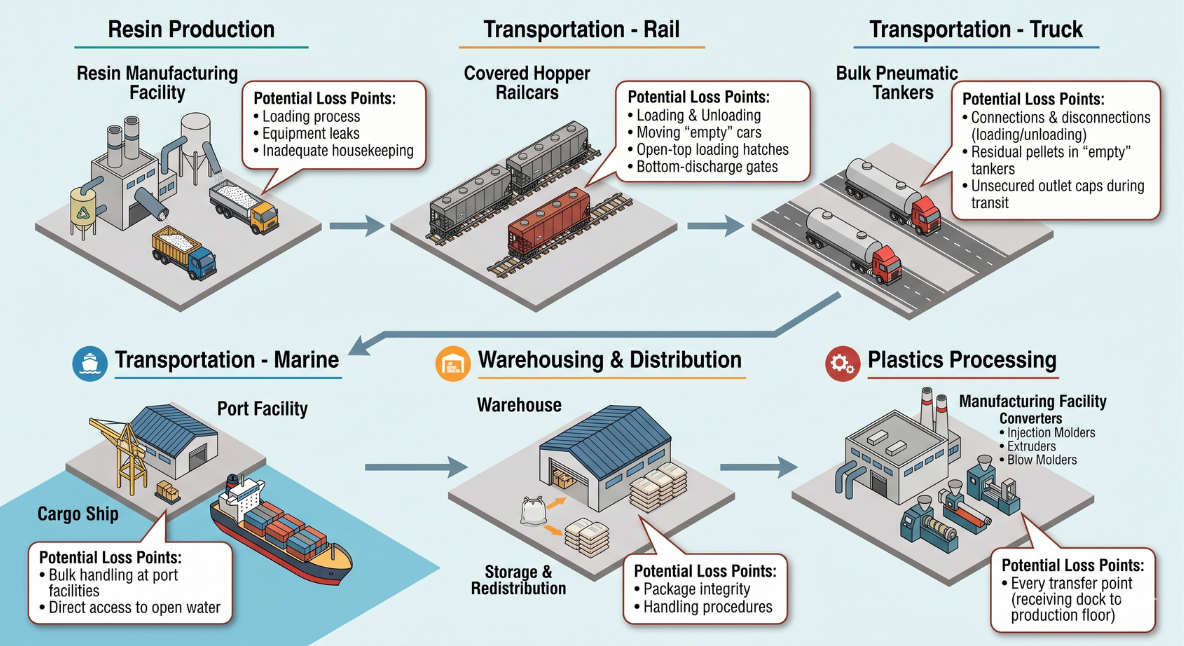
Loading and Unloading Operations
Industry best practice frameworks identify loading and unloading as the highest-risk activity across the entire plastic resin supply chain, at every stage from resin producer to final processor. Large volumes of material are in motion, connections are made and broken among equipment components, and the pace of operations creates conditions in which small losses go unnoticed or unaddressed.
At rail facilities, covered hopper railcars are unloaded through bottom-discharge gates and pneumatic systems. During connections and disconnections between the discharge gate and the receiving hose or pipe, pellets can escape. Pellets can also be released from loading hatches on top of railcars during filling operations. Even after a railcar is considered “empty,” residual pellets remain on internal surfaces and in corners and escape during subsequent car movement or cleaning operations.
At truck facilities, bulk pneumatic tankers are loaded and unloaded through hose-and-coupler connections at the bottom of the tank. Connections and disconnections are loss points. Outlet caps that are not properly sealed allow residual pellets to escape during transit.
At marine and port facilities, pellet handling often involves transferring bulk material between vessels, vehicles, and storage structures. Loss at marine facilities can have immediate environmental consequences given their proximity to open water.
Transfer Points Within Facilities
Inside a plastics processing or warehousing facility, pellets move between silos, hoppers, conveyors, blenders, and processing machines. Each transition point is a potential loss point, whether pellets are falling, being pneumatically conveyed, or manually moved. Worn equipment seals, overfilling, and equipment malfunctions can all release pellets onto floors.
Pellets on facility floors may appear to be an internal housekeeping issue, but facilities have floor drains and connections to the exterior stormwater system. Pellets swept to the edges of a production floor or carried toward drains during routine cleaning can exit the building if drainage is not properly filtered.
Packaging Failures
Pellets are shipped and stored in multi-wall paper bags, octabins, flexible intermediate bulk containers (FIBCs or “big bags”), and bulk supersacks. These containers are subject to damage from forklift handling, stacking pressure, moisture degradation, and normal wear. A torn bag in a warehouse or a split octabin in a rail yard can release hundreds of pounds of pellets in a single incident.
Proper packaging integrity management, including inspecting incoming shipments, handling containers carefully, and resealing damaged packaging promptly, is a core component of industry BMP frameworks. But packaging failures will always occur to some degree, which is why facility-level containment, such as trays, berms, and drain protection, is essential as a secondary line of defense.
Outdoor Bulk Operations
Many transfer operations occur outdoors: rail unloading, truck loading and unloading at receiving docks, and open-air transloading operations. Outdoor operations expose any spilled pellets to wind and rain immediately. Even a modest breeze can carry pellets significant distances from a spill site, and a rain event during or after a spill will carry pellets directly into drainage systems.
Best practice guidance specifically addresses outdoor operations: pave loading and unloading areas wherever possible to facilitate cleanup; install berms or slopes to prevent pellets from reaching unpaved areas and drains; place catch trays at all railcar and truck unloading valves; and equip all outdoor areas with readily accessible brooms, vacuums, and containment supplies.
Storm Drain Entry
A storm drain without a screen or filter is a direct pipeline from the facility surface to the nearest waterway. Industry guidance consistently identifies storm drain filtering as the last line of defense against pellet loss to the environment and the single highest-priority installation for any pellet-handling facility.
Pellets that have escaped any earlier containment and reached the ground surface will, given any appreciable surface water flow, travel toward and into the nearest storm drain. Facilities that have addressed primary containment at transfer points but left storm drains unprotected remain vulnerable to pellet loss from surface spills or releases.
The path from storm drain to waterway is typically short. Municipal stormwater systems are designed to move large volumes of water quickly, with minimal opportunity for capture of floatable contaminants along the way.
Residual Pellets in "Empty" Containers and Vehicles
One of the less-obvious yet well-documented sources of pellet loss is residual pellets in containers, railcars, and trucks that are classified as “empty” for transport purposes. A covered hopper railcar returned to a resin producer after unloading may contain residual pellets clinging to interior surfaces, trapped in corners, or accumulated at low points. If those cars are moved without proper sealing of all openings, pellets will escape during transit.
Operation Clean Sweep’s® Best Management Practices explicitly identify residual pellets from “empty” bulk cars and trucks as a primary area for improvement. Sealing all outlet caps using 1/8″ stranded steel cable or equivalent is a standard BMP requirement. Facilities are also advised to design or modify loading systems so that transfer lines can be completely emptied after loading, with residual resin discharged into a contained area rather than onto the ground.
Spills During Emergencies and Accidents
Rail incidents, truck accidents, facility equipment failures, and extreme weather events can all result in large-scale pellet releases that overwhelm routine containment. A single incident involving a bulk hopper car can release large quantities of pellets at a location far removed from the originating facility.
While individual accidents are unpredictable, their consequences can be mitigated through preparedness: spill containment supplies on hand, employees trained in plastic pellet spill response, and emergency containment equipment, including drain seals, deployed and ready.
The Role of Stormwater
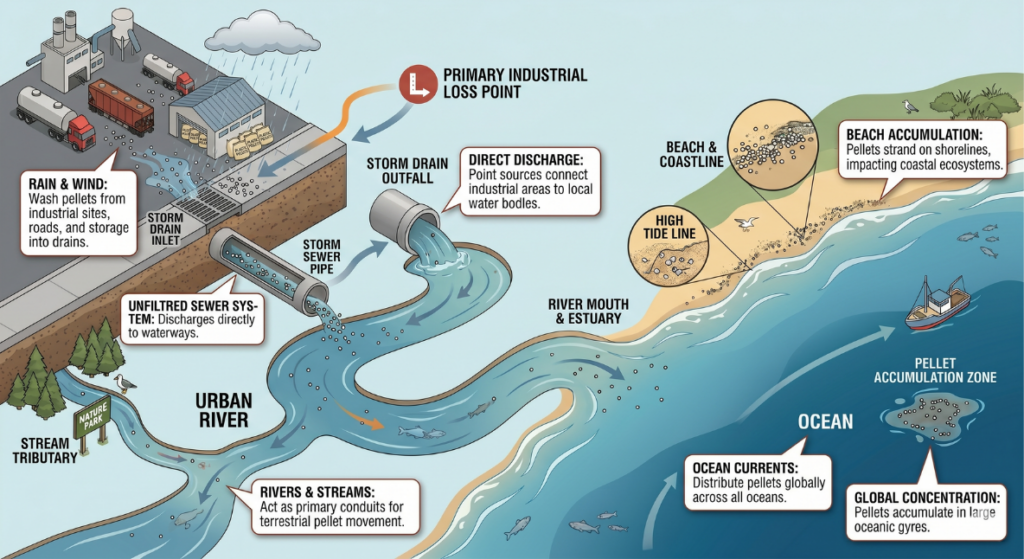
Stormwater is the primary transport mechanism for pellet loss to the environment. Even pellets that are not immediately adjacent to a drain will eventually reach one if surface runoff is sufficient. Facilities in high-rainfall regions face elevated exposure, but no facility is immune. A single rain event following an outdoor spill can carry plastic pellets from the point of release to the nearest stormwater outlet.
Federal stormwater discharge regulations under the NPDES permitting program (40 C.F.R. §122) govern what facilities are permitted to discharge in stormwater. Plastic pellets released in stormwater are subject to regulation, and facilities that fail to implement adequate stormwater BMPs may face significant penalties. Full regulatory context is covered on our Impact page.
Addressing Every Escape Pathway
Every pathway outlined above has a corresponding containment solution:
- Rail transfer operations: Ultra-Pellet Pan (standard or composite) installed beneath railcar discharge areas
- Loading and unloading areas: Ultra-Pellet Berm, Ultra-Containment Berm, Ultra-Berm Builder Plus for area containment; Ultra-Utility Tray at individual discharge points
- Rail car clean-out: Ultra-Pipe Sock on discharge hoses; Ultra-Pellet Drain integrated into flexible berms for water drainage with pellet retention
- Storm drains: Ultra-Storm Guard, HD, HDC, or Plus in catch basins; Ultra-Pellet Trap for high-capture-efficiency applications; Ultra-Filter Sock around drain perimeters
- Emergency drain closure: Ultra-Drain Seal for immediate, complete drain blocking
- Recovered pellet storage: Ultra-Pellet Collection Box for secure, labeled interim storage
UltraTech International‘s product line addresses each of these scenarios with purpose-built, engineered solutions.
Questions?
Let’s stop plastic pellet pollution together. If you have questions about any of our products, fill out the form below, and we’ll be in touch soon.