
Plastic Pellet Pollution Kills
The raw material for almost every plastic product is also a nightmare for our environment. They pollute our rivers, streams, oceans, and beaches, and kill fish and wildlife every day.
A Documented, Multi-Dimensional Problem
The consequences of plastic pellet pollution are not speculative. They have been documented by researchers, regulatory agencies, and the plastics industry itself over decades. The impacts span environmental, safety, operational, and regulatory dimensions and are relevant to every organization in the plastic resin supply chain.
Plastic resin pellets—polyethylene, polypropylene, and dozens of other resin types—are handled in such large volumes that even small loss rates are significant. A single facility losing a fraction of a percent of its annual throughput can contribute thousands of pounds of pellets to the environment each year. Multiply that across thousands of facilities worldwide, and the cumulative burden becomes substantial.
The good news is that pellet loss is not an inevitable byproduct of plastic manufacturing. It can be solved at the source with best management practices, including capturing pellets during handling and transport with the right plastic pellet containment solutions.
Environmental Impact
Wildlife Ingestion
The most widely documented environmental consequence of plastic pellet pollution is wildlife ingestion. Researchers have reported that seabirds, sea turtles, and fish ingest plastic pellets, mistaking them for fish eggs and other small food items. The size and shape of nurdles closely resemble the natural prey of multiple species, and their buoyancy concentrates them at the water’s surface, where surface-feeding birds and fish are most active.
When plastic pellets are ingested by wildlife, they often cannot pass through the animal’s digestive tract. Unlike food, plastic does not break down in the stomach. Accumulated pellets fill the digestive system, creating a false sense of satiation. The animal feels full without receiving any nutritional value. The result, documented across multiple species, can be malnutrition and, in cases of heavy pellet accumulation, starvation.
Seabirds are among the most studied populations in this regard. Nesting colonies have provided researchers with direct evidence: plastic pellets have been found in the stomachs of adult birds and in the regurgitated feeding material delivered to chicks. Fish and sea turtles have similarly been documented with plastic pellets in their digestive systems.
Pellet ingestion represents a failure of industrial containment, not consumer disposal. These are preproduction materials that enter the environment before any consumer product is made. Better industrial containment directly reduces wildlife exposure.
Chemical Toxicity
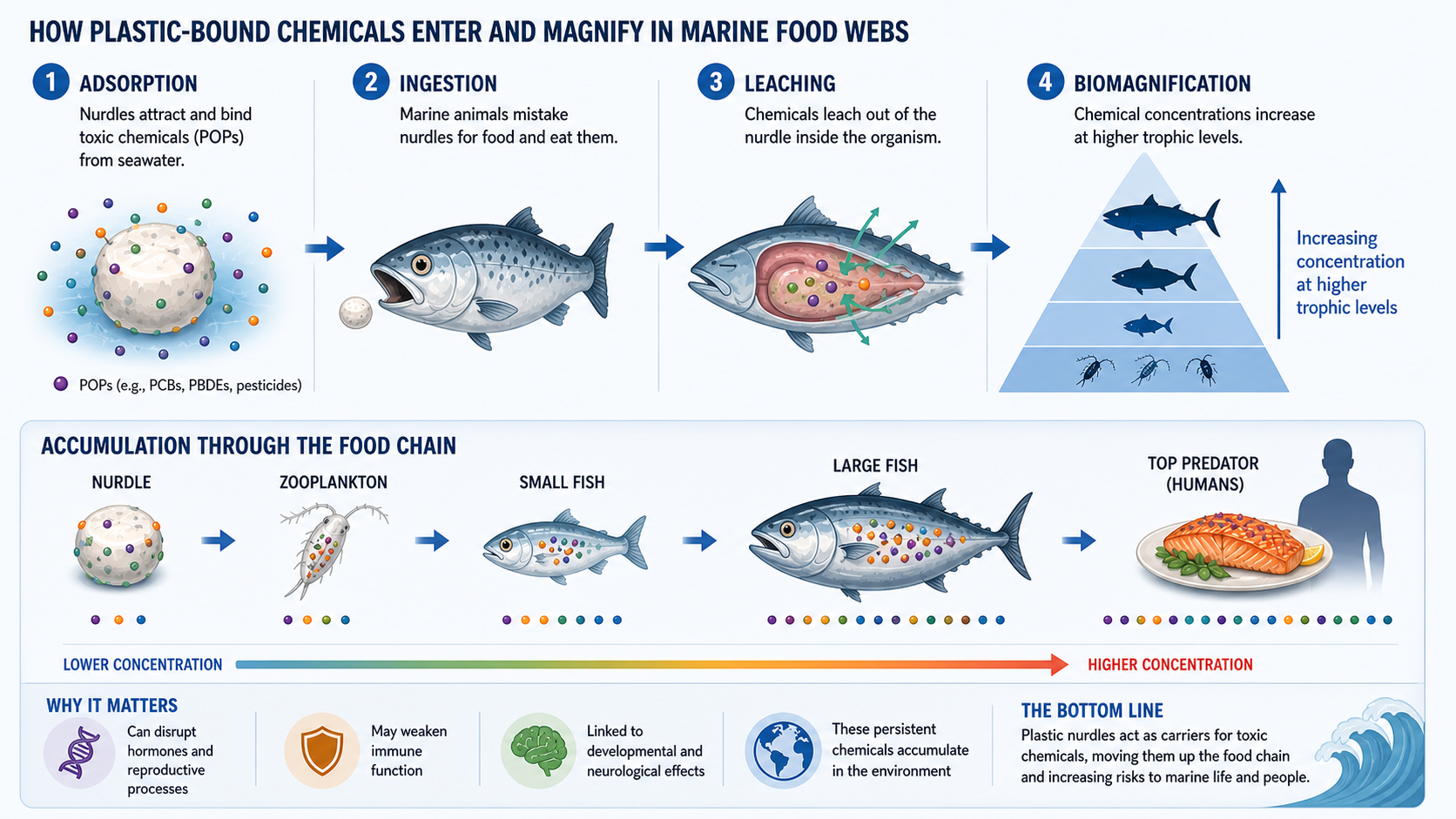
Physical blockage is not the only harm nurdles cause when ingested. Plastic polymers act as effective concentrators of chemical pollutants in the marine environment, a phenomenon sometimes called the “toxic sponge” effect.
Nurdles adsorb persistent organic pollutants (POPs), including polychlorinated biphenyls (PCBs), polybrominated diphenyl ethers (PBDEs), and other halogenated compounds, from the surrounding water onto their surfaces. Research has documented that nurdles can concentrate these pollutants to levels orders of magnitude higher than those in surrounding seawater. When a marine animal ingests a nurdle, it ingests both the polymer and this accumulated chemical payload.
Nurdles also contain manufacturing additives that can leach out over time, particularly as pellets weather in the marine environment. These vary by resin type—polypropylene pellets, for example, commonly contain nucleating agents and clarifying agents in addition to the stabilizers, flame retardants, and colorants found across most resin types—and many of these substances can disrupt endocrine function, impair reproduction, and accumulate in fatty tissue.
Through predator-prey relationships, these chemical burdens move up the food chain via biomagnification, meaning animals higher on the food chain, including fish species consumed by humans, can accumulate disproportionate chemical loads from plastic ingestion by the organisms they eat.
Persistent Accumulation and Fragmentation
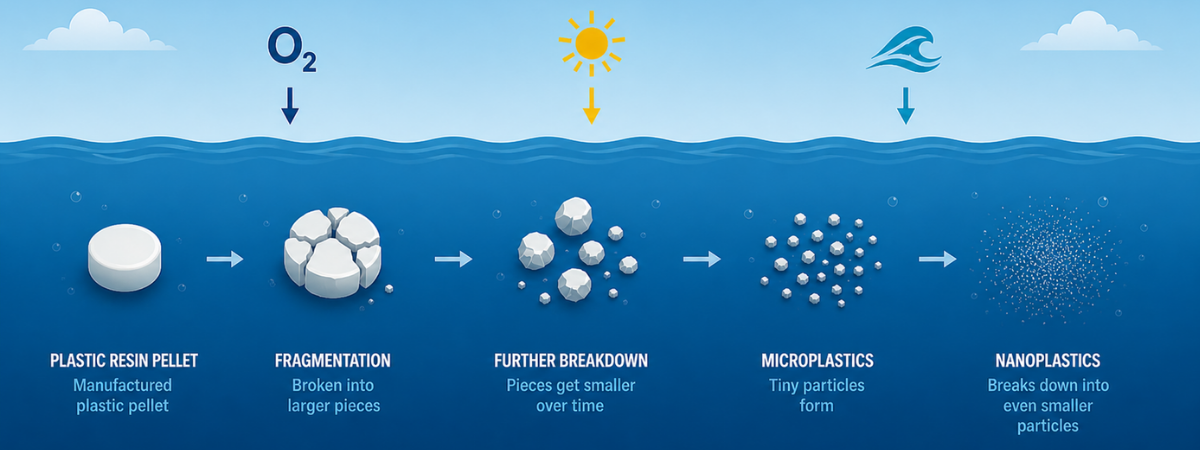
Unlike organic pollution, which degrades through natural biological and chemical processes, plastic pellets do not biodegrade in any meaningful timeframe. Once in the environment, they persist. They accumulate in ocean gyres and on shorelines across the world.
Under UV radiation and wave action, nurdles gradually fragment into smaller and smaller particles, transitioning from microplastics to nanoplastics. As particles decrease in size, they become capable of crossing biological barriers that larger particles cannot penetrate. Nanoplastics have been detected in human blood, lung tissue, and other organs in recent medical research, though the full implications remain under study.
Prevention at the industrial source is the only practical strategy. Once pellets are distributed across beach, sediment, and open-water environments at any scale, large-scale recovery is effectively impossible.
Research estimates that plastic pellets are the second-largest direct source of microplastic pollution in the ocean by weight. Operation Clean Sweep® estimates that more than 490,000 tons of pellets escape the global plastic supply chain annually, reflecting the cumulative effect of routine losses across thousands of facilities worldwide, not just catastrophic spills.
Ecosystem-Level Effects
The impacts of nurdle pollution extend beyond individual animals. At sufficient concentrations, microplastic particles interfere with the feeding behavior of zooplankton, the microscopic organisms that form the base of the marine food web. Zooplankton that mistake plastic particles for food reduce their intake of actual phytoplankton, which can affect reproduction and population dynamics across entire oceanic food webs.
Coastal communities dependent on fishing and tourism experience economic consequences when nurdle spills contaminate beaches and nearshore waters. The persistence of pellets in the environment means that a single large spill can affect a shoreline or fishing area for years.
Workplace Safety Impact
Plastic pellets on facility floors are a documented workplace hazard. OSHA’s plastics industry guidance notes that walking surfaces with spilled resin pellets or beads provide minimal traction and increase the risk of slips and falls, among the most common workplace injuries in the plastics industry. Slip-and-fall accidents are a leading cause of incidents in the plastics industry, as small, round, smooth pellets on hard surfaces create underfoot conditions that are unpredictable and dangerous, behaving like ball bearings.
Operation Clean Sweep® identifies worker safety as one of its three core program purposes, alongside preserving water quality and protecting the environment. Better pellet containment, including catch trays, berms, and other plastic pellet collection systems that keep pellets off the floor, directly reduces exposure to workplace injuries.
Slip-and-fall incidents carry measurable costs: lost work time, workers’ compensation claims, medical expenses, productivity disruption, and higher insurance premiums. The case for pellet containment at the facility level is not purely environmental. It is also a direct business and operational risk issue.
Regulatory and Compliance Impact
Penalties for stormwater violations vary by jurisdiction but are real and significant. California regulations, for example, provide for civil penalties of up to $3,000 per incident for stormwater regulation violations, with unauthorized discharge constituting a misdemeanor carrying fines of up to $1,000 per day.
State-level requirements add additional exposure in many jurisdictions. Documented pellet releases can trigger permit reviews and require implementing additional controls, creating ongoing compliance costs that can significantly exceed the upfront cost of containment equipment.
Facilities that handle plastic pellets operate within a regulatory framework that governs stormwater discharge. The National Pollutant Discharge Elimination System (NPDES), established under the Clean Water Act and administered through 40 C.F.R. §122, requires facilities that discharge stormwater to obtain permits and implement Best Management Practices to prevent pollutants, including plastic pellets, from entering waterways.
Stormwater Pollution Prevention Plans (SWPPPs), required under many NPDES permits, must identify potential pollutant sources and describe the BMPs used to control them. Plastic pellets must be addressed in the plan wherever they are handled.
Regulatory Trends
The regulatory environment surrounding pellet loss is actively evolving. In the United States, the NPDES framework already provides a basis for regulating pellet discharge through stormwater permits.
At the international level, the European Union reached a provisional agreement in 2025 on legislation to address plastic pellet loss, as part of its broader microplastic pollution strategy.
Facilities with documented containment programs and proactive stormwater management practices will be better positioned to demonstrate compliance as regulatory scrutiny increases.
Reputational and Supply Chain Impact
For companies that supply plastic resin or plastic products to major-brand customers, pellet containment practices are increasingly included in supply chain sustainability assessments. Facilities with documented, verifiable plastic pellet management programs are better positioned to respond to customer inquiries than facilities without them.
Operation Clean Sweep®’s OCS Blue Verification program requires third-party inspection of all participating facilities against more than 25 defined management practices, providing a specific, credible credential for customer and regulatory conversations. In 2024 alone, more than 200 external inspections were conducted by independent third-party inspectors globally, and more than 20,000 workers at U.S.-based OCS member facilities received formal training on pellet loss prevention.
The Business Case for Containment
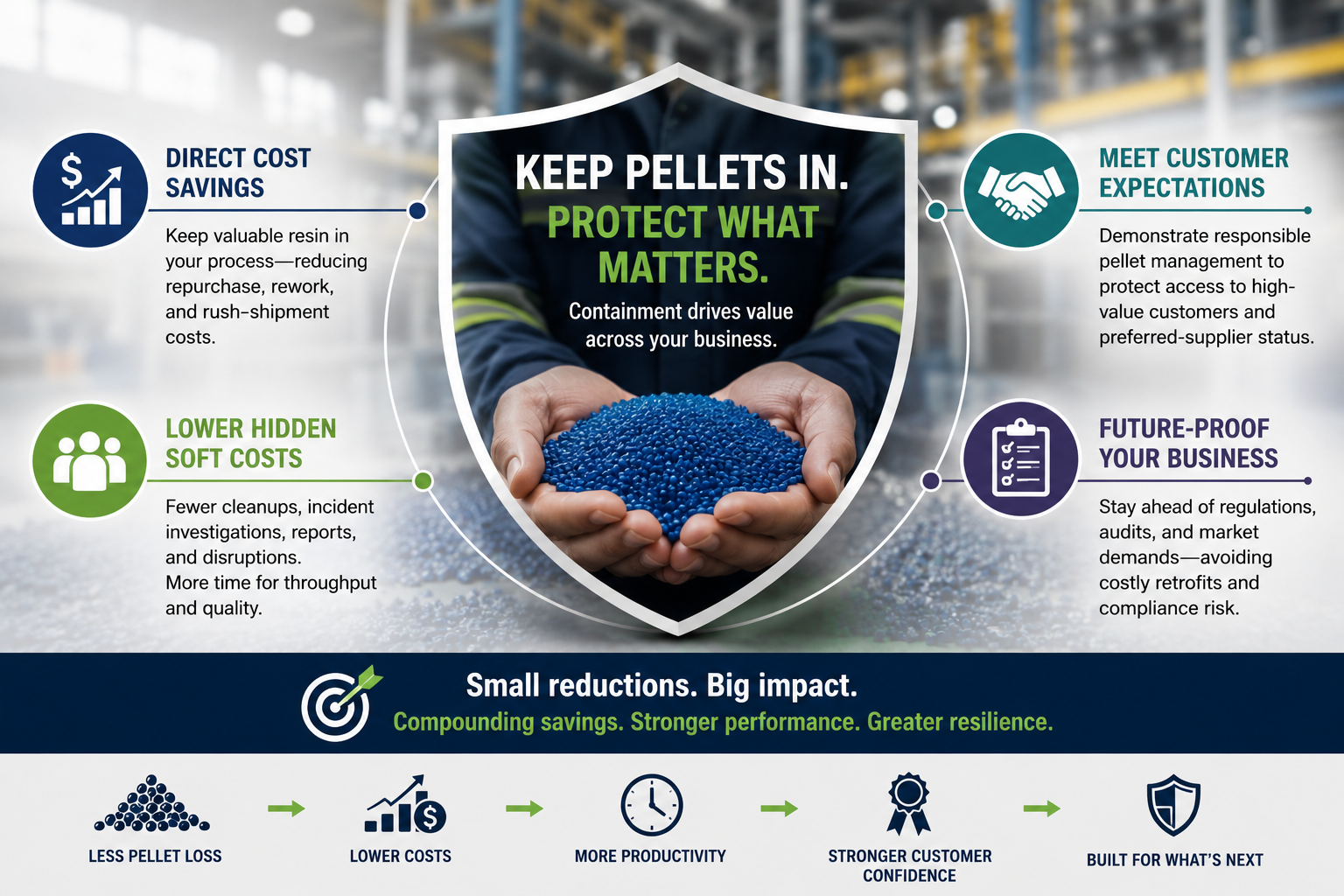
Pellet containment directly protects margins. Every pellet that stays in your process is material you do not have to repurchase, remanufacture, or rush‑ship to meet orders in a tight resin market. Treating pellet loss as a controllable cost center—rather than an unavoidable nuisance—creates immediate savings and more predictable production economics. Even small percentage reductions in loss compound over time across multiple shifts, lines, and sites.
Containment also reduces the hidden soft costs that rarely show up on a single invoice. Uncontrolled pellet loss drives unplanned housekeeping, incident investigations, customer documentation, and internal reporting to EHS and management. Each of these adds friction to day‑to‑day operations and quietly erodes productivity. Facilities that invest in keeping pellets where they belong free up operator time, supervisor attention, and maintenance resources to focus on throughput and quality instead of cleanup and damage control.
From a commercial standpoint, pellet containment is increasingly a basic requirement of doing business. Large buyers and brand owners are tightening expectations and asking for evidence that resin handlers are managing pellets responsibly, not just within plant boundaries but across their logistics footprint. Strong containment performance can preserve access to high‑value customers, support preferred‑supplier status, and reduce the risk of losing business to competitors that can demonstrate better control and reporting.
Finally, proactive containment is a hedge against future regulatory and market change. As pellet loss becomes more visible to communities and policymakers, new requirements—audits, reporting, third‑party certification, and tighter discharge limits—are already emerging in key markets. Facilities that act now to reduce loss and document performance will be better positioned to comply at lower cost, negotiate from a position of strength with regulators and customers, and avoid the rushed, expensive retrofits that follow a high‑profile incident or rule change. In this context, pellet containment is not just good practice; it is a strategic investment in the business’s resilience and competitiveness.
Questions?
Let’s stop plastic pellet pollution together. If you have questions about any of our products, fill out the form below, and we’ll be in touch soon.